
AI&DHI Innovation Spotlight: A Primary Care-Based Weight Navigation Program

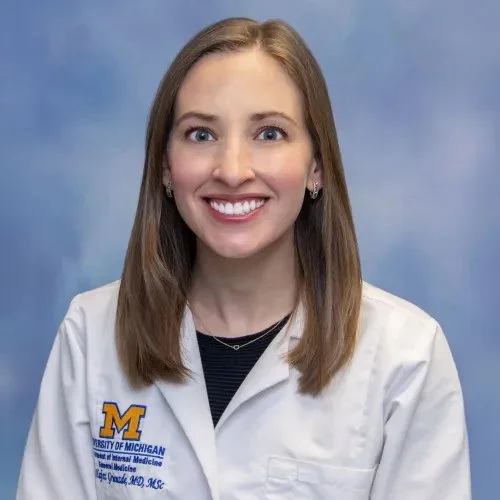
This edition of the AI&DHI Innovation Spotlight is focused on work led by Dr. Dina Griauzde, Assistant Professor of Internal Medicine and Director of Research and Quality for Michigan Medicine’s Weight Navigation Program (WNP).
With the support of AI&DHI, and joined by multidisciplinary experts from across the University of Michigan and the VA Ann Arbor Healthcare System, Dr. Griauzde and and clinical colleagues including Dr. Andrew Kraftson (WNP Program Director), Dr. Amal Othman (WNP Medical Director for Family Medicine), and Dr. Patricia Arizaca-Dileo (WNP Medical Director for Internal Medicine) developed a program aimed at streamlining access to personalized, evidence-based weight management care for patients with obesity.
The program consists of weight-focused visits with obesity medicine-trained primary care physicians. WNP aims to connect patients with treatments tailored to their individual preferences, needs, and health goals, including diet and physical activity interventions, medical nutrition therapy, weight-loss medications, and bariatric surgery. With funding from NIH/NIDDK, Caswell Diabetes Institute and support from Departments of Internal Medicine and Family Medicine, the team led several studies to evaluate the program’s clinical effectiveness and to understand how the program could be implemented to improve treatment access and weight-related outcomes in a primary care setting.
Obesity is a common, complex and chronic health condition, and many patients face significant barriers to receiving weight loss treatment tailored to their individual needs within the traditional primary care setting. According to Dr. Griauzde, there are several key drivers behind these barriers including clinicians’ knowledge gaps, clinical time constraints, and data gaps in the electronic health record (EHR).
“The metric used to clinically evaluate the effectiveness of weight-change interventions is percent weight change, yet this value is not routinely displayed in the EHR, limiting a clinician’s ability to track a patient’s progress over time,” said Griauzde. “In addition, routine primary care visits often occur only every six to twelve months, and many health systems lack strategies for identifying and supporting patients who are not meeting weight-change goals in the time between appointments.”

WNP aims to connect patients with treatments tailored to their individual preferences, needs and health goals, including diet and physical activity interventions, medical nutrition therapy, weight-loss medications, and bariatric surgery.
To address these challenges, Dr. Griauzde collaborated with Dr. Joyce Lee, Robert P Kelch M. D. Professor of Pediatrics and Associate Director for Informatics and Clinical Research Innovation at the Caswell Diabetes Institute and her team to build a dedicated Weight Navigation Program Dashboard. The tool automatically calculates and displays percent weight change relative to a patient’s initial program visit directly within the EHR.
In addition, Dr. Griauzde worked with virtual care team members at U-M Health to establish a remote monitoring protocol using Michigan’s Patient Outreach Texting Application. Through this system, patients could self-report their weight via text message directly into the EHR, updating the dashboard and helping to guide care team outreach during the time between scheduled appointments.
“If a clinician only sees a patient once or twice a year, they miss critical windows in which they can adjust care if that patient’s progress stalls. By establishing clearer longitudinal metrics and creating touchpoints between visits, we can help primary care teams deliver timely, proactive support instead of them having to wait for the next routine appointment,” said Griauzde.
AI&DHI supported this work by helping the team identify and define the patient populations from which the researchers gathered their prevalence data, empowering two NIH-funded grant applications. Dr. Griauzde noted that extensive cross-departmental collaboration was a key driver in the project’s success, with the researchers leveraging the expertise of not only clinicians but also informatics specialists, dieticians, social workers, quality improvement leaders, policy experts and operational partners.
“Bringing together primary care clinicians, informatics specialists and operational leaders allowed us to address structural barriers from every angle,” she said. “Support from AI&DHI then enabled us to build a collaborative framework that ensures these tools will translate into practical, scalable support for patients in real-world clinical settings.”
Weight Navigation Program Team
Dina Griauzde, MD, MSc, DABOM; Andrew Kraftson, MD; Amal Othman, MD, DABOM, FOMA; Patricia Arizaca-Dileo, MD; Arielle Schaffer-White, MD; Johnathon Gabison, MD; Asim Kagzi, MD; Emily Collins, MHA, RD; Sarah Irving, RD; Jessica Bible, MSW; Shelley Stoll; Shalini Bhattacharya, MD; Cassie Turner, PhD, LMSW; Lily Lev, BS; Arrice Shipley, MD; Wala Tout, MD; Tanvi Shah, MBBS
Relevant Publications
Developing a Weight Navigation Program to Support Personalized and Effective Obesity Management in Primary Care Settings: Protocol for a Quality Improvement Program with an Embedded Single-Arm Pilot Study. Primary Health Care Research & Development, 2022. PMID: 35234116
A Primary Care-Based Weight Navigation Program. JAMA Network Open, 2024;7(5):e2412192. PMID: 38771575
GLP-1 RA Use and Weight Loss Among Patients in a Weight Navigation Program Versus Primary Care: A Matched Cohort Study. Obesity Science & Practice, 2026;12(2). DOI: 10.1002/osp4.70136
Disclosures
The University of Michigan Caswell Diabetes Institute provided funding support for this project.
This project was also supported through the following grants:
K23DK123416: “A Multilevel Intervention to Support Weight Loss Among Individuals With Prediabetes in Primary Care Settings.” National Institutes of Health/National Institute of Diabetes and Digestive and Kidney Diseases
R01DK139094: “Testing a novel Weight Navigation Program to overcome multilevel barriers to obesity treatment in primary care settings”. National Institutes of Health. United States Department of Health and Human Services. MIweigh.org
Grant # A-42225: Innovations to Advance the Delivery of Holistic, Evidence-Based Obesity Care to Veterans. Eli Lilly and Company
About AI & Digital Health Innovation
AI & Digital Health Innovation (formerly Precision Health at U-M) is dedicated to empowering researchers at the University Michigan to change the future of digital healthcare. They work with multi-disciplinary teams of health providers, basic scientists, engineers, and administrators to tackle the most difficult research problems and help rapidly bring ideas to the bedside. For more information visit aidhi.umich.edu.