
AI&DHI researchers land $2.9 million grant to advance the science of AI at the bedside
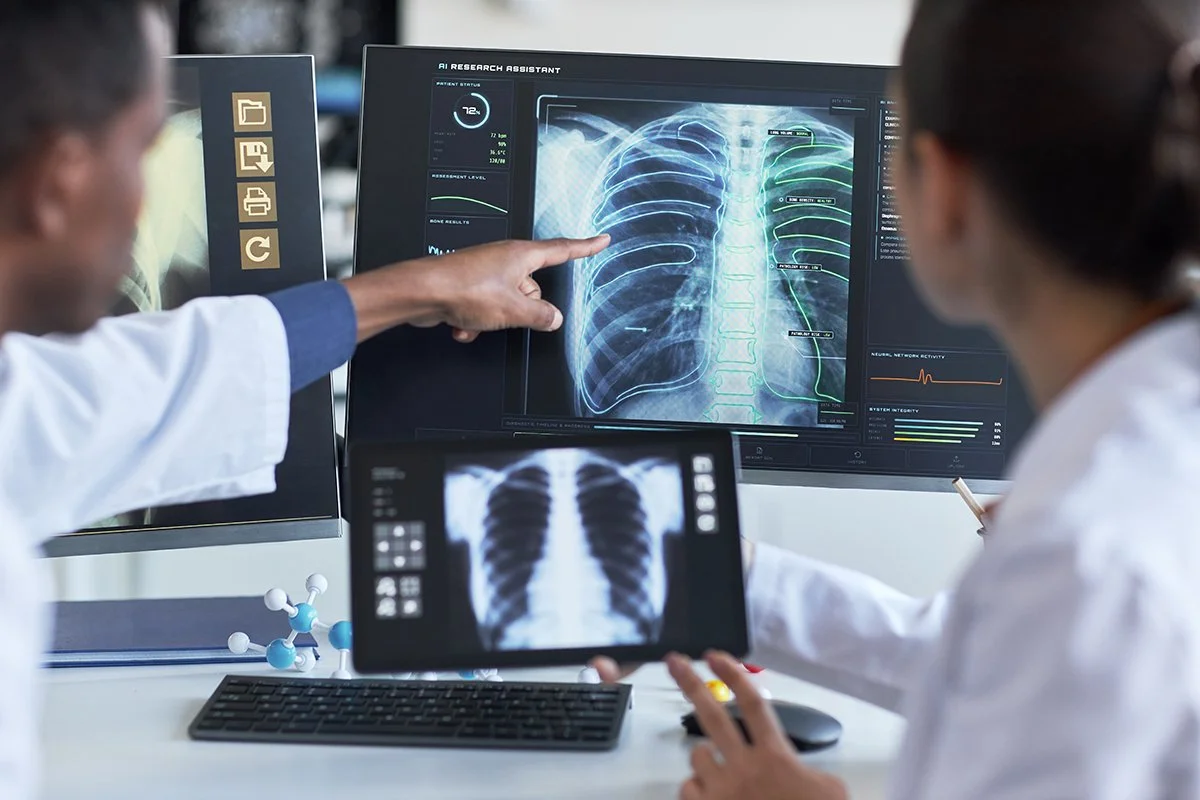
Using AI&DHI’s chest X-ray dataset and PRISM platform, the team will study how AI models can be thoughtfully implemented while keeping human clinician judgment at the center.
ANN ARBOR – University of Michigan researchers from Michigan Medicine and the College of Engineering, with the support of AI & Digital Innovation (AI&DHI), have secured a $2.9 million R01 renewal from the National Institutes of Health (NIH) to further their research into how AI can be safely and effectively integrated into patient care.
The grant builds on the team’s earlier work studying how AI-generated recommendations can affect clinicians’ diagnostic accuracy in the setting of acute respiratory failure (ARF). The team now aims to move this research closer to the bedside by developing, deploying and evaluating their own AI model to support the timely and accurate diagnosis of the underlying cause(s) of ARF and acute dyspnea, or shortness of breath.
“Diagnosing the cause behind a patient’s shortness of breath can be a challenge because several serious conditions like pneumonia, heart failure and COPD can present with similar symptoms,” said Dr. Michael Sjoding, co-principal investigator on the grant, Associate Director of Research Implementation at AI&DHI and Associate Professor of Pulmonary and Critical Care Medicine in the Division of Internal Medicine. “Our work aims to clarify how AI can potentially augment this process while keeping human clinician judgment at the center.”
In their foundational study, a clinical vignette survey study published in JAMA in 2023, the researchers found that AI-generated recommendations, when paired with image-based explanations, improved clinicians’ diagnostic accuracy over baseline levels. However, when presented with recommendations from a model that was systematically biased—that is, the model’s training led it to consistently over- or under-diagnose certain conditions and/or patient populations—the clinicians’ accuracy dropped significantly. In addition, the presence of image-based explanations failed to offset the harm from these recommendations.
“What we learned from this work is that we can’t expect clinicians to serve as safety nets for flawed AI systems,” said Dr. Sjoding. “These tools need to be carefully developed, evaluated and implemented with close attention to how they’re actually being used.”
“We can’t expect clinicians to serve as safety nets for flawed AI systems. These tools need to be carefully developed, evaluated and implemented with close attention to how they’re actually being used.”
The researchers used AI&DHI’s chest X-ray dataset as the basis for the vignettes in their initial study. With the renewed funding from NIH, they will begin linking these images to clinical records from the electronic health record. They will then leverage AI&DHI’s PRISM platform to develop, deploy and evaluate their AI model for diagnosing the underlying cause of acute dyspnea. This will allow the team to study how clinicians use the model most effectively and how they interact with AI-supported recommendations in a real-world care setting.
According to Dr. Jenna Wiens, co-principal investigator on the grant, Professor of Computer Science and Engineering at the College of Engineering and a co-director of AI&DHI, the insights gleaned from studying their model in a real clinical environment could prove vital as the presence of AI continues to grow throughout health care.
“It’s not enough to demonstrate that an AI model works; we also need to understand what happens once it’s integrated into clinical workflows – how it actually impacts clinician decision making,” said Dr. Wiens. “Evidence from studies like ours could help health systems make more informed decisions about if and how to integrated such tools in the delivery of patient care.”
“This project truly demonstrates how AI&DHI’s research infrastructure can propel ideas toward impact,” said Cinzia Smothers, Director of Research Services at AI&DHI. “We are thrilled to support this team and to provide investigators across U-M with the data tools and resources that enable them pursue this kind of ambitious, collaborative research which has immense potential to improve patient care.”
Principal Investigators
Michael Sjoding, MD, MSc (Internal Medicine, Division of Pulmonary and Critical Care Medicine); Jenna Wiens, PhD (Electrical Engineering and Computer Science, Division of Computer Science and Engineering); Nikola Banovic, PhD (Electrical Engineering and Computer Science, Division of Computer Science and Engineering); Liyue Shen, PhD (Electrical Engineering and Computer Science, Division of Electrical and Computer Engineering); Stephanie Parks Taylor, MD, MS (Internal Medicine, Division of Hospital Medicine; Learning Health Sciences)
Referenced Study
Jabbour, S., Fouhey, D., Shepard, S., Valley, T. S., Kazerooni, E. A., Banovic, N., Wiens, J., & Sjoding, M. W. (2023). Measuring the impact of AI in the diagnosis of hospitalized patients. JAMA, 330(23), 2275. https://doi.org/10.1001/jama.2023.22295
About AI & Digital Health Innovation
AI & Digital Health Innovation (formerly Precision Health at U-M) is dedicated to empowering researchers at the University Michigan to change the future of digital healthcare. They work with multi-disciplinary teams of health providers, basic scientists, engineers, and administrators to tackle the most difficult research problems and help rapidly bring ideas to the bedside. For more information visit aidhi.umich.edu.