

HELPR LLM Tools
Our HELPR (Health data Exploration Powered by AI for Research) Tools leverage AI to improve the way researchers interact with health data.
Finding, managing, and prospectively using health data for research is complicated. Our suite of HELPR LLM Tools make it eaiser for our health AI researchers to interact with data, build cohorts, and deploy models for pilots/trials.
Jump to a HELPR Tool:
PRISM | MiCohort Builder Assistant | MiQuery Builder Assistant
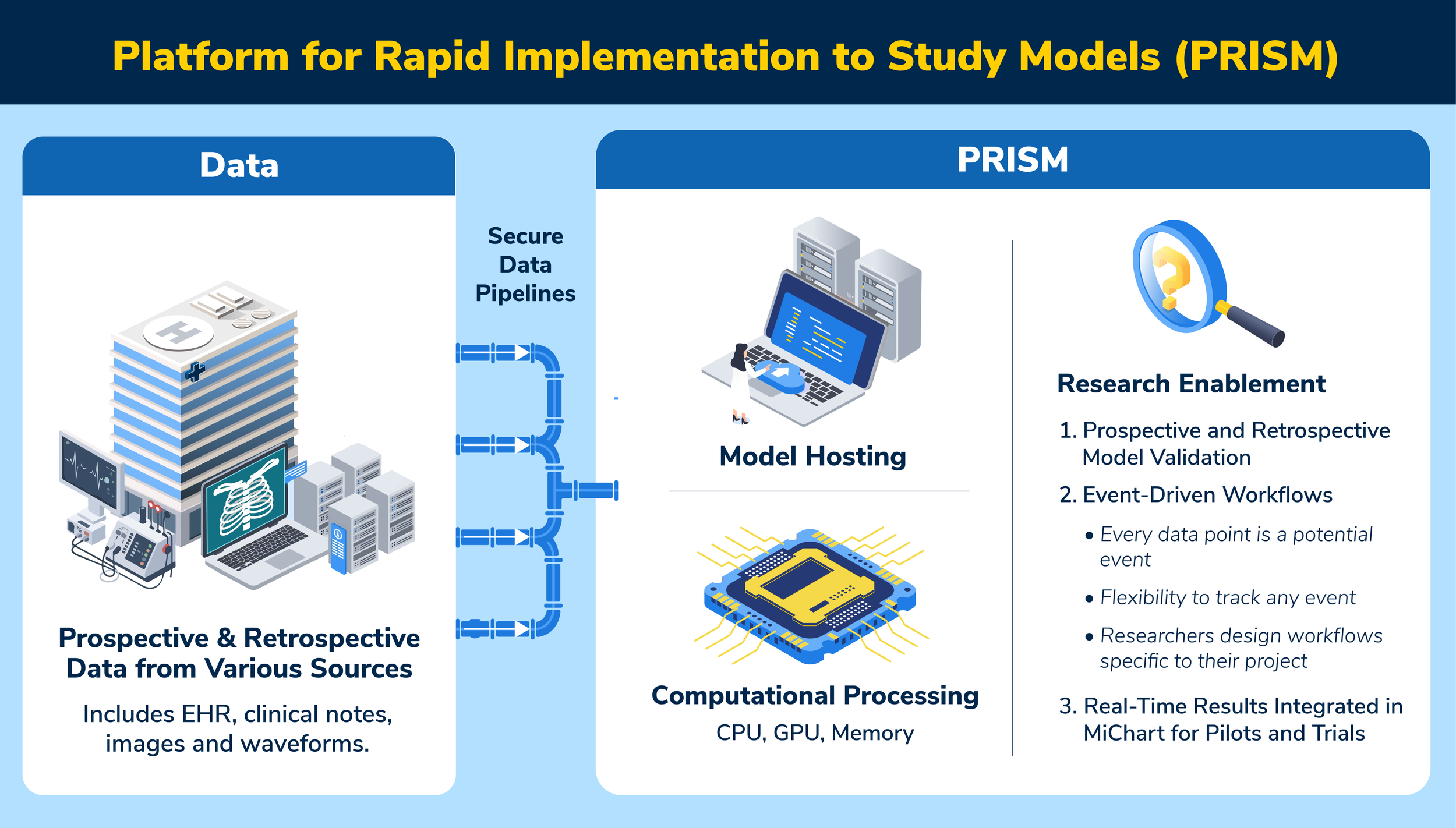
PRISM allows researchers to stay focused on their research by connecting models to the data, compute, and workflows needed for clinical research.
PRISM (Platform for Rapid Implementation to Study Models)
The systems shouldn’t slow the science.
Health AI research moves slowly not because of the science, but because of the systems. Getting a model connected to the right data, the right workflows, and the right clinical infrastructure takes time researchers don't have. PRISM (Platform for Rapid Implementation to Study Models) removes that friction — providing secure, IA-approved hosting and rapid access to EHR, imaging, and waveform data so researchers can quickly move from development to clinical testing. With full ownership of their models and our dedicated research success team handling the technical details, researchers can focus on what matters: proving their model works.
Features include:
Free, on-premise hosting leveraging HITS hardware available to all campus and Michigan Medicine health AI researchers
Rapid access to all data types and sources including EHR, clinical notes, images, and waveforms
Adaptable as data sources evolve over time
Easily integrates with flowsheets, PACS, REDCap, and more
For more information, contact:
Cinzia Smothers, Director,
AI & Digital Health Research Services

MiCohort Builder Assistant
The Cohort Builder Assistant helps researchers identify patients who meet inclusion criteria for research studies.
Identifying patients fitting the criteria for clinical trial recruitment is a time-intensive and operationally burdensome component of clinical studies. Manual schedule screening, fragmented structured data filters, and limited access to outpatient notes slow recruitment and delay trials.
The Study Cohort Builder LLM solves this by:
Combining structured filters with semantic note analysis
Leveraging LLMs to extract eligibility criteria from unstructured clinical notes
Providing a user-friendly interface define inclusion and exclusion criteria through natural language interactions
Reducing expensive coordinator time spent manually reviewing charts.
For more information, contact:
Cinzia Smothers, Director,
AI & Digital Health Research Services

MiQuery Builder Assistant
This LLM will build a SQL query that you can run in the Deidentified RDW to find the data you’re looking for.
The MiQuery Builder Assistant is powered by UMGPT and designed specifically for querying Michigan Medicine patient data. The MiQuery Builder Assistant translates natural language research questions into DeID RDW -ready SQL queries in seconds, expanding data access to our researchers and accelerating their workflows.
Features include:
Generates SQL code based on natural language prompts.
Automatically identifies the correct DeID RDW tables, joins, filters, and code sets required.
Understands the DeID RDW chema.
Trained on our data documentation, there is no need to explain the table structures, relationships, or data types. Users can get started with their research question immediately.
Supports iterative prompting.
Remembers chat history, so users can ask to adjust inclusion/exclusion criteria or output formats on the fly.
For more information, contact:
Cinzia Smothers, Director,
AI & Digital Health Research Services